
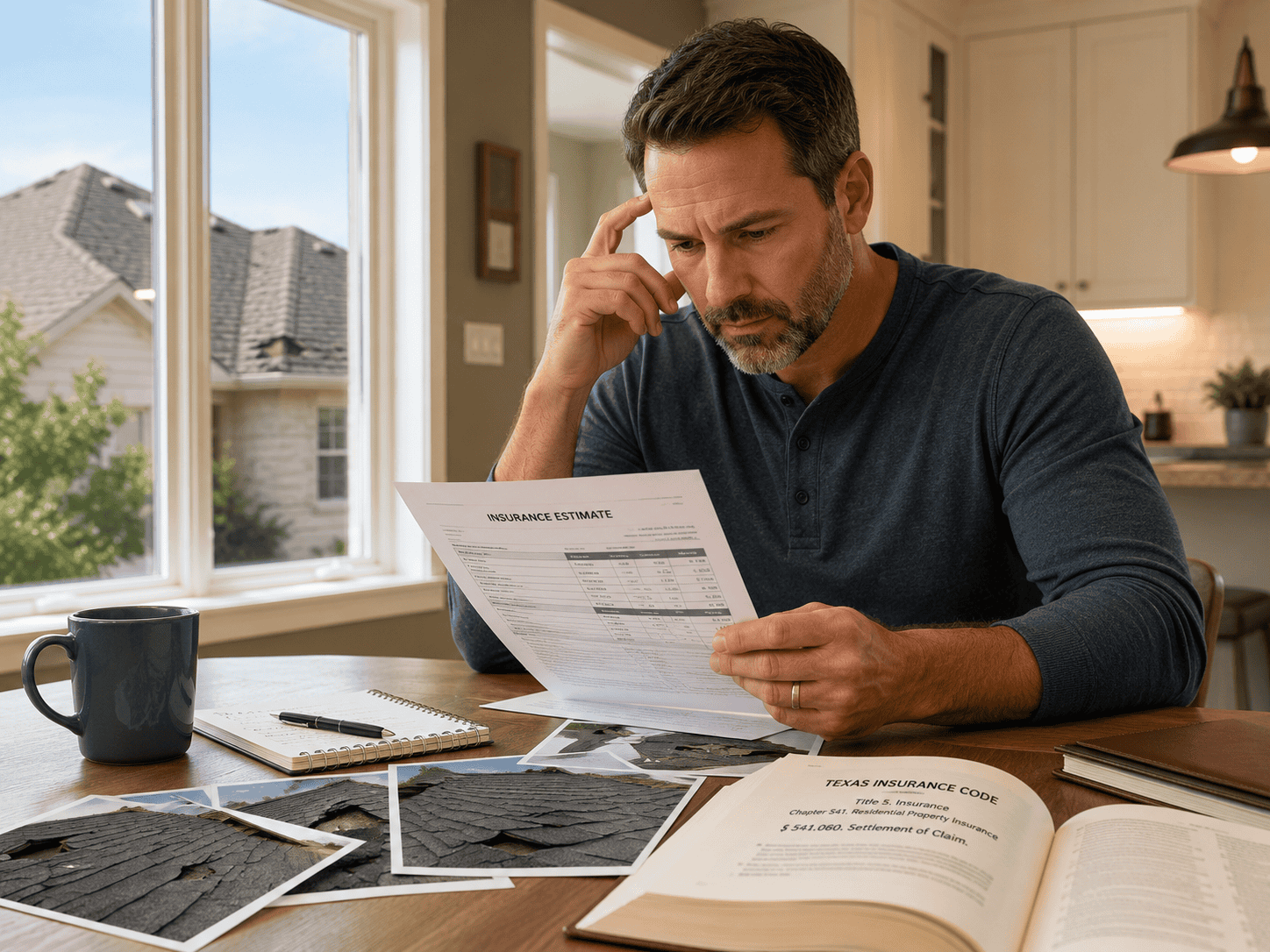
What to Do If Your Texas Roof Insurance Claim Is Denied or Underpaid
A denied or underpaid roof insurance claim does not always mean the homeowner is out of options. Insurance estimates can sometimes miss damage, use incorrect measurements, omit required construction items, or rely on incomplete documentation.
The first step is to understand exactly what the insurance company approved, denied, or left out. From there, the homeowner may be able to request clarification, provide additional construction documentation, ask for a reinspection, review the policy’s appraisal provision, consult a licensed public adjuster, file a complaint with the Texas Department of Insurance, or speak with an attorney.
Rooftop Roofing and Remodeling does not act as a public adjuster and does not provide legal advice. Our role is limited to the construction side of the project, including inspections, photos, measurements, estimates, and explaining the repair or replacement scope.
Do Not Assume the First Answer Is the Final Answer
A denied claim or low insurance estimate can be frustrating, but homeowners should not automatically assume the first decision is the only decision available. Claims can involve missed damage, incorrect measurements, missing construction items, pricing differences, or incomplete documentation.
If something does not look right, the homeowner can ask questions and request a clear explanation. Depending on the circumstances, possible next steps may include requesting a reinspection, submitting additional contractor documentation, asking for a supervisor review, reviewing the appraisal provision in the policy, consulting a licensed public adjuster, filing a complaint with the Texas Department of Insurance, or speaking with an attorney.
Coverage and payment decisions belong to the insurance company and the policyholder. Rooftop Roofing and Remodeling can provide construction-related documentation, including photos, measurements, estimates, and repair or replacement scopes, but we do not interpret policy coverage or represent homeowners in insurance disputes.
Was the Claim Denied, Underpaid, or Below the Deductible?
These situations are different, and the next step may depend on which one applies.
A denied claim generally means the insurance company determined that the damage, cause of loss, or requested work is not covered under the policy.
An underpaid claim means the insurance company approved at least part of the loss, but the estimate may not include the full construction scope, accurate measurements, necessary materials, or current repair costs.
A below-deductible claim means the insurance company may have recognized covered damage, but calculated the amount of the loss as less than the homeowner’s deductible.
Homeowners should review the claim letter and insurance estimate carefully so they understand which decision was made and why.
Understanding ACV, RCV, Depreciation, and Your Deductible
Insurance estimates often use several terms that can make the payment difficult to understand.
Actual Cash Value, or ACV, generally means the estimated cost of the damaged property or repairs after applicable depreciation has been deducted.
Replacement Cost Value, or RCV, generally refers to the estimated cost to repair or replace the damaged property without deducting depreciation, subject to the policy’s terms, limits, and exclusions.
Depreciation is the reduction in value based on factors such as age, condition, and expected useful life. Depending on the policy, some withheld depreciation may be recoverable after the work is completed and the required documentation is submitted.
The deductible is the portion of a covered loss the homeowner is responsible for paying. It is normally subtracted from the insurance payment and is separate from depreciation.
Because policies differ, homeowners should review their claim documents and ask the insurance company to explain how ACV, RCV, depreciation, and the deductible were calculated.
Why the First Insurance Payment May Not Be the Final Amount
The first insurance payment may be based on the insurer’s initial estimate and may not reflect the final construction cost.
Depending on the policy and the claim, the initial payment may be based on actual cash value, with some depreciation withheld until repairs are completed and supporting documentation is submitted.
The estimate may also change if additional damage is discovered, measurements are corrected, code-required items are documented, or legitimate construction items were omitted from the original scope.
When the contractor’s documented repair scope differs from the insurance estimate, the homeowner may submit photographs, measurements, estimates, invoices, or other construction documentation for the insurance company to review.
The insurance company makes the final coverage and payment decisions. A contractor’s role is to explain the construction scope and provide accurate supporting documentation.
Review the Insurance Estimate Carefully
Homeowners should compare the insurance estimate with the visible damage and the actual construction requirements for the property.
Items that may need closer review can include:
- Missing roof slopes or sections
- Incorrect roof measurements
- Vents, flashing, drip edge, or pipe boots
- Gutters, fascia, soffit, siding, or exterior trim
- Interior damage related to the loss
- Damaged decking discovered during tear-off
- Building-code requirements that may apply to the repair
- Labor, material, disposal, or access items needed to complete the work
A difference between the contractor’s estimate and the insurance estimate does not automatically mean the insurer made an error. The difference should be documented and explained clearly so the homeowner can ask the insurance company to review it.
Ask the Insurance Company for Clarification
If part of the claim was denied, omitted, or paid differently than expected, the homeowner can ask the insurance company for a written explanation.
Useful questions may include:
- What specific damage or repair items were denied?
- Why were certain items omitted from the estimate?
- Which measurements, prices, or policy provisions were used?
- Can the claim be reviewed by a supervisor?
- Can a reinspection be scheduled?
- What additional documentation would the insurance company consider?
The homeowner should keep copies of claim letters, estimates, emails, photographs, and notes from phone calls. Clear records make it easier to track what was requested, what was provided, and how the insurance company responded.
Submit Additional Construction Documentation
If the contractor’s documented repair scope differs from the insurance estimate, the homeowner may submit additional construction information for the insurance company to review.
Useful documentation may include:
- Clear photographs of visible damage
- Roof measurements and diagrams
- A detailed construction estimate
- Material specifications
- Building-code requirements that may apply
- Manufacturer installation requirements
- Invoices, receipts, or reports for completed work
- Documentation of damage discovered after tear-off
The documentation should explain the construction issue clearly without making coverage or payment conclusions. The insurance company decides whether the policy covers an item and whether additional payment is owed.
Understanding the Contractor’s Limited Role in a Texas Insurance Claim
Texas Insurance Code § 4102.163 limits what a roofing contractor can do during an insurance claim. A contractor who provides or may provide the repair work cannot act as a public adjuster or advertise that they adjust insurance claims for that property.
A contractor can inspect the property, document visible damage, take photographs, prepare measurements, write a construction estimate, explain what work may be needed, and discuss technical construction information with the homeowner, insurance company, or adjuster.
A contractor cannot act as a public adjuster when the contractor is also providing or may provide the repair work. That means the contractor should not interpret policy coverage, negotiate the claim as the homeowner’s representative, advertise claim-adjusting services, or represent the homeowner in an insurance dispute.
Rooftop Roofing and Remodeling stays on the construction side of the process. We provide inspections, documentation, measurements, estimates, and repair or replacement scopes. Coverage and payment decisions remain with the insurance company and the policyholder.
Review the Policy’s Appraisal Option
Some Texas homeowners insurance policies include an appraisal provision that may help resolve a disagreement about the amount of a covered loss.
In appraisal, the homeowner and the insurance company generally each select an appraiser. The two appraisers evaluate the amount of the loss. If they cannot agree, an umpire may be used to help reach a decision.
Appraisal may be useful when the disagreement involves measurements, pricing, the repair scope, or the amount needed to complete covered repairs. It generally does not decide whether the policy covers the damage in the first place.
Before demanding appraisal, the homeowner should:
- Read the appraisal provision in the policy
- Check for deadlines and notice requirements
- Understand the appraiser’s fee
- Understand that the homeowner may also be responsible for part of the umpire’s cost
- Ask whether the disputed issue concerns the amount of loss or a coverage decision
- Consider consulting an attorney when the policy language or dispute is unclear
Appraisal can sometimes be a less expensive option than hiring a public adjuster, but it is not free and it is not appropriate for every dispute. The homeowner should understand the policy requirements, costs, and limits before proceeding.
Consider Mediation or Alternative Dispute Resolution
Some insurance disputes may be addressed through mediation or another form of alternative dispute resolution. This process uses a neutral third party to help the homeowner and insurance company discuss the disagreement and explore a possible resolution outside of court.
Mediation may be worth considering when both sides are willing to participate but have not resolved the disagreement through documentation, reinspection, or direct communication.
Before agreeing to mediation, the homeowner should understand:
- Whether participation is voluntary or required by the policy
- Who will select and pay the mediator
- Whether any agreement will be binding
- What documents should be provided
- Whether legal advice may be appropriate before signing an agreement
Mediation does not guarantee a settlement, but it may provide another path for resolving a dispute without immediately filing a lawsuit.
File a Complaint With the Texas Department of Insurance
A homeowner may file a complaint with the Texas Department of Insurance if they believe the insurance company, agent, or adjuster did not handle the claim properly.
A complaint can be useful when the homeowner believes the insurer failed to explain its decision, did not respond within required timeframes, or may have violated Texas insurance rules or the terms of the policy.
When filing a complaint, the homeowner should provide:
- The policy number and claim number
- Copies of claim letters and insurance estimates
- Relevant photographs and construction documentation
- Emails or written communications with the insurance company
- A clear timeline of what happened
- A concise explanation of the problem and the requested review
The Texas Department of Insurance can review complaints involving regulated insurance companies, agents, and adjusters. However, it may not be able to resolve every factual dispute or force payment when the disagreement depends on disputed damage, causation, or policy interpretation.
Consider Hiring a Licensed Public Adjuster
A licensed public adjuster represents the policyholder during the insurance claim process. Unlike the contractor, a public adjuster may review the claim, discuss coverage issues, prepare claim documentation, and negotiate with the insurance company on the homeowner’s behalf.
A public adjuster may be useful when there is a significant disagreement about the amount of loss, the repair scope, or how the claim has been handled.
Before hiring one, homeowners should:
- Verify the adjuster is licensed in Texas
- Review the contract carefully
- Understand the fee structure
- Ask what services are included
- Confirm how and when the contract can be canceled
- Keep copies of all documents provided
Hiring a public adjuster does not guarantee that the insurance company will approve additional payment. It gives the homeowner a licensed representative who can handle claim-related advocacy that a contractor cannot legally provide.
Speak With a Property Insurance Attorney When Necessary
Some insurance disputes involve policy language, coverage questions, missed deadlines, allegations of improper claim handling, or substantial financial disagreements that go beyond the contractor’s role.
A homeowner may want to consult an attorney who handles Texas property insurance claims when:
- The claim has been denied based on policy language
- The dispute involves coverage rather than only the amount of loss
- Appraisal may not address the central issue
- Important deadlines or limitation periods may apply
- The homeowner believes the claim was handled improperly
- The potential loss is large enough to justify legal review
An attorney can explain the homeowner’s legal rights, review the policy and claim history, and advise whether legal action is appropriate. Rooftop Roofing and Remodeling does not provide legal advice or recommend that every insurance disagreement requires an attorney.
How Rooftop Can Help With the Construction Side
Rooftop Roofing and Remodeling does not act as a public adjuster and does not provide legal advice. We do not interpret insurance policy coverage, negotiate claim settlements, or represent homeowners in insurance disputes.
Learn more about our insurance claim assistance services and how Rooftop documents the construction scope after storm damage.
Our role is limited to the construction side of the project. Depending on the property and the damage, we may provide:
- A roof and exterior inspection
- Photographs of visible damage
- Roof measurements and diagrams
- A detailed construction estimate
- A repair or replacement scope
- Material and installation information
- Documentation of code-related construction requirements
- Information about damage discovered during the work
- Technical discussion of our estimate with the homeowner, insurance company, or adjuster
Coverage and payment decisions remain with the insurance company and the policyholder. Our goal is to provide accurate construction information so the homeowner can better understand what may be required to properly repair the property.
Know Your Options Before Giving Up on the Claim
A denied or underpaid roof insurance claim does not always mean the process is over. The right next step depends on whether the disagreement involves the repair scope, the amount of loss, policy coverage, claim handling, or missing documentation.
Homeowners may be able to request clarification, seek a reinspection, submit additional construction documentation, review the policy’s appraisal provision, file a complaint with the Texas Department of Insurance, consult a licensed public adjuster, or speak with a property insurance attorney.
Rooftop Roofing and Remodeling can help document the construction side of the loss with inspections, photographs, measurements, estimates, and repair or replacement scopes.
Need a professional inspection or construction estimate? Contact Rooftop Roofing and Remodeling to schedule a free on-site estimate.